The post What is the need for Airport Analytics? appeared first on Airport Analytics.
]]>Talking of business at airports, airports need to adjust their operations to accommodate higher passenger numbers, increased air traffic and commercial services. This burgeoning demand at airports means need for growth in infrastructure and staffing while ensuring productivity and service quality levels. And of course all this with an eye on the bottom line!
Increasing passenger volumes and air traffic also means increasing data. This data can be analyzed using BI tools and techniques to give insights enabling decision support for all what, why, when & where questions for the business! Analyses include historical data analysis, what-if scenario analysis as well as predictive analytics. A proper analytics engine is required that factors cross-linking between various departments at an airport to ensure that the management has sufficient information on operations, finance, commercial, infrastructure, HR etc. to take accurate and timely decisions.
One Stop Shop: Airport Analytics Solution
GrayMatter’s Airport Analytics solution is a comprehensive analytics tool for airports business. It doesn’t matter what existing systems you have, Airport Analytics is equipped with pre-defined connectors to 50+ systems that guarantee fast and accurate insights. Contextual to mention that deployment time for Airport Analytics is around 1/3rd of the time needed for any other traditional BI tools. Airport Analytics is a truly compelling and unparalleled solution in the vast subject area of aviation data analytics.
Let’s walk through some scenarios. Passengers are the end customers and so passenger experience is a key consideration. On-time performance (OTP), for instance, is a critical parameter determining passenger experience. OTP is one of the 400+ pre-defined KPI’s in Airport Analytics, with ability to immediately indicate the reason for any variance, which could be late passengers, catering, ground handling etc. Non-aero revenue is another critical factor which also reflects the extent of customer engagement at the airport. Airport Analytics allows store by store analysis based on key KPIs and provides insights to maximize non-aero revenues. Talking of car parks, Airport Analytics provides analytics on utilization even at an hourly level. Not just that, Airport Analytics also includes Car Park Revenue Management (CPRM) module which provides dynamic car park pricing based on predictive analytics algorithms. This module helps in reducing car park vacancy and maximizes car park revenues.
Talking of hourly reporting, it reminds me of time dimension and also brings me to a key feature of Airport Analytics. Airport Analytics always provides reports and analytics with respect to or compared to time period(s) which could be weekly, monthly, quarterly, yearly or even daily and hourly!

Airport Analytics not only helps in airports business but also enables mutual business interests of airports and airlines by providing suggestions on new airlines that could be invited , inputs on strategies to grow business with high performing airlines through new routes, greater frequencies of flights etc. The solution also addresses ground handling analytics that directly impacts the airline performance in terms of turnaround time between touch-down and take-off, service quality provided to passengers in terms of baggage handling and on-time delivery, bus service from aircraft to airport and vice-versa and others. There are several other illustrations to this effect, including operational metrics like air traffic movement, on-time departure and arrival etc. which serve as inputs for airline performance.
The Airport Analytics Coverage
Airport Analytics as a path-breaking solution in the Aviation data analytics space offers unique value proposition to its users. The modular structure of the solution ensures sharp, defined benefits for specific business needs at airports. The image below depicts the functional coverage of the solution
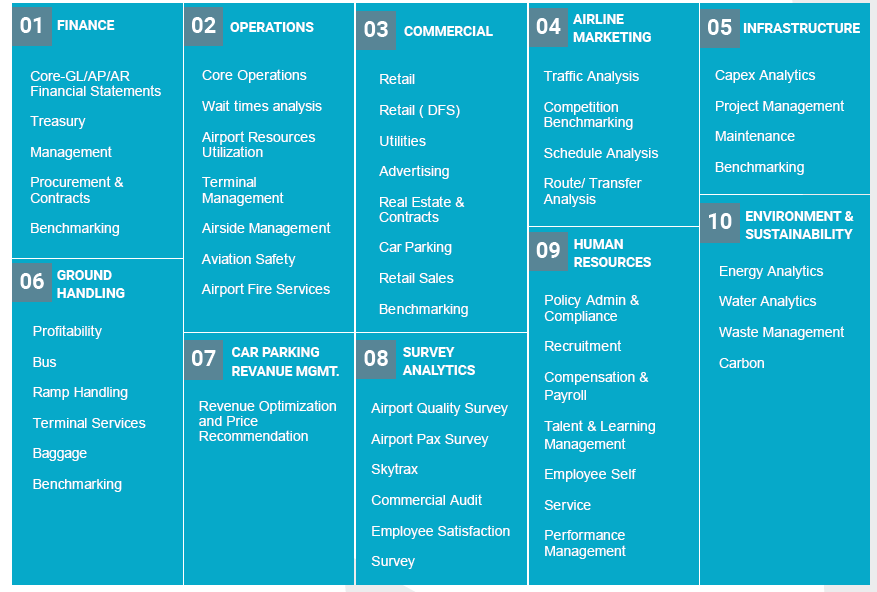
In terms of capabilities and features, Airport Analytics offers the following out-of-the-box for each of the airport departments:
- ‘Out of the box ‘ full range of dashboards, reports and analytics designed specifically to promote best practices in an airport organization across all department. ‘Out of box ‘ complete statistical model for predictive analysis
- ‘Out of Box’ data integration approach with all major airport systems
- Single unified architecture: covering all the elements of BI system like Reporting, Dashboarding, Adhoc Analytics, OLAP/Cube Multidimensional analytics, ETL Tools, Data Mining, Pre-built data model and pre-built BI contents along with planning and budgeting capabilities
- The system has provision for displaying consolidation of all these information across multiple airports under the management, wherever applicable. It also provides self-service capability to users to create their own reports based on business needs
- The solution supports the calculation of derived data like ratios that are not normally available in the data source for the purpose of comparison or analysis like arithmetic operations (sum, difference, percentage, % difference, % total, etc.).
- The principle of Four Ws (What, Where, When and Why) has been kept in view, for getting the complete story on a subject, while designing the dashboards for the flow of navigation by the user. It is expected that when the user arrives at the end of navigation, he would have identified the pain area, or opportunity for improvement as the case may be, to address the issue effectively.
The post What is the need for Airport Analytics? appeared first on Airport Analytics.
]]>The post Airport Analytics – A game changer for International Airports appeared first on Airport Analytics.
]]>
Data sources of Airports
One of the main sources of data at airports is the Airport Operational Data Base (AODB) where the The Cargo terminals, fuel farm, flight catering establishments, ground handling agencies etc., which are a part of the airport flight handling, have their own systems suitable for their business. Almost all the retail outlets, food court establishments, Duty-free Shopping complex have their respective E-POS systems recording every transaction. The standard SAP systems are used for financial applications at the airport. In cases where any of these systems does not exist, the data pertaining to those units are compiled in Excel formats manually at pre-determined intervals.
Key features of the Airport Analytics Solution
Analytics of Data consolidated from multiple underlying systems in respect of Air Traffic Movements, Passengers, Cargo volumes, On-Time Performance of flights, Aeronautical Revenues, Aero-related Revenues (e.g., Revenue to the airport accruing from Cargo, Ground Handling, Flight catering and other operations), Non-Aeronautical Revenues, Airport Financials, Receivables, Expenditure, Airport Service Quality Survey covering Operational, Commercial and Financial airport functions. The users have the ability to change filters to slice and dice the data presented in dashboards by using GrayMatter’s Airport Analytics Solution. They can also drill into the details by selecting sections of the dashboards.
- The Airport Analytics solution has been configured to analyze the data for any pre-determined period of time (e.g., monthly, MTD, QTD, YTD).
- The users will be able to drill-down to the next level in the business hierarchy intuitively.
- The dashboards support the reports to be scheduled periodically as desired by user.
- The solution has the ability to display consolidation of all these information across multiple airports under the management.
- It provides the ability to create reports based on the business needs of the airports.
- The solution supports the calculation of derived data like ratios that is not available in the data source for the purpose of comparison or analysis like Arithmetic (sum, difference, Percentage) (% difference, % total, etc.)
- Dashboards provide a centralized, easy-to-handle view of the airport’s situation, with integrated alerts and communication.
- The data displayed in dashboards represents the current information in underlying SAP system.
- Some key & relevant What-If? scenarios at airports are also induced in the solution.
The Airport Analytics solution provides the management with information & insights they need, organized & processed in a way that supports intelligent & informed decision-making, strategic planning & analysis, besides tactical responses to changing conditions. Business-driven pre-determined alerts have been incorporated in the solution which ensures Airports take corrective actions much before an incident occurs. The Airport Analytics solution enables Global International Airport Operators to take profitable and growth-oriented decisions besides identify problem areas way ahead and spot opportunities to remain way ahead of competition always.
The post Airport Analytics – A game changer for International Airports appeared first on Airport Analytics.
]]>